Event
What if we dreamed bigger?
7 April 2025
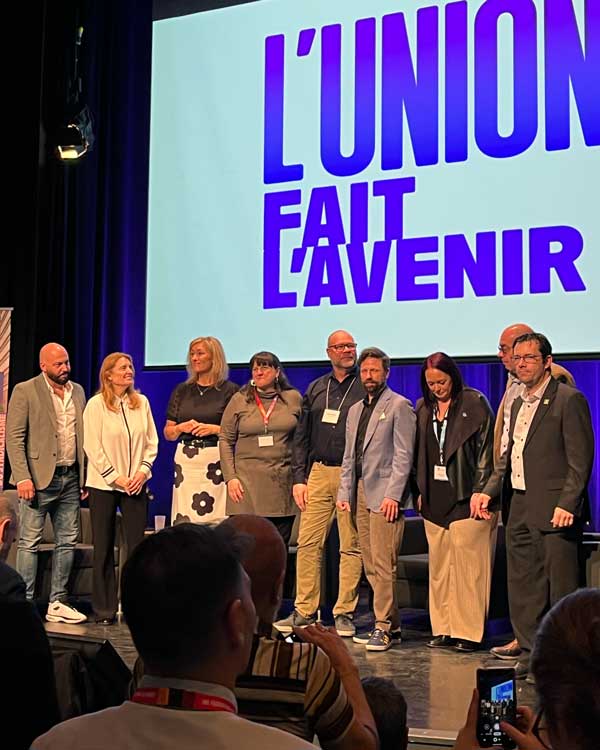
A look back at the first meeting of the États généraux du syndicalisme
Summary: On March 31, Quebec’s nine main labour organizations launched an unprecedented initiative: the États généraux du syndicalisme. This first gathering was rich in reflection, memory and hope. We were proud to take part in it.
“Unionism is made of faces, voices and lived realities that deserve to be heard.”
Joint statement by the nine union presidents

On March 31, something important was set in motion. In a room filled with activists, union leaders and researchers, one thing was clear: the Quebec labour movement needs a breath of fresh air. And that renewal must be built collectively.
A turning point
“L’union fait l’avenir.” It’s more than a slogan. It’s a commitment. A commitment to rebuild the balance of power, to put solidarity back at the heart of our movement, and to reflect, honestly and without taboos, on the future of unionism. Over the course of three panels and several hours, memories, critiques, frustrations and visions were shared with sincerity.
The facts are clear. The world of work is changing rapidly. Lockouts are on the rise, strikes are declining, job insecurity is growing, and younger workers have a different relationship to unions. And yet, the attacks don’t let up. From the rise of the political right to bills like PL89 and assaults on the right to strike and union democracy, our ability to act is under pressure.
But how do we respond? And above all: can we still dream bigger?
Looking inward
One message kept coming back: the need for self-reflection. “If our members aren’t showing up, maybe it’s because we’ve lost touch with them,” said Magali Picard, President of the QFL. Others pointed to the weight of bureaucratic structures, the challenge of reaching younger generations, and the rise of individualism, which undermines collective strength.
Mélanie Hubert (FAE) spoke of the need to restore meaning to union involvement. “Our members are looking for tangible relationships, for a form of intelligent unionism that reflects their realities.” She called on us to do a better job of explaining our struggles and to help workers rediscover the value of democracy in the workplace.
Guillaume Bouvrette (SPGQ) emphasized the importance of dialogue between unions. “Let’s serve unionism with a capital U.”


Stories to carry forward
The past was not forgotten. In fact, it was omnipresent. Luc Vachon (CSD) recalled key legal battles that have weakened unions over the years, such as the amendment of Article 45 and the elimination of fixed-term collective agreements. He also highlighted a crucial victory: Quebec’s anti-scab legislation, described as “a turning point that helped clean up labour disputes.”
Julie Bouchard (FIQ) delivered a powerful feminist message. She linked union struggles to the ongoing fight for abortion rights and accessible public healthcare. She remembered the resilience of healthcare workers during the pandemic, holding protest signs and demanding the tools they needed to protect lives.
Christian Daigle (SFPQ) revisited some of the greatest collective gains: labour standards, occupational health and safety, paid sick days, pay equity. “These wins protect all workers today, and we need to remember where they came from.”
These stories are the foundation for what comes next. But to build on them, we must pass them on.
The courage to rethink
In a world where institutions are increasingly questioned, how can unions still act as a counterpower? That was the question raised by Éric Gingras (CSQ), who called for a return to our broader social mission, beyond simply applying the collective agreement.
Robert Comeau (APTS) emphasized the need to put workers front and centre. “They need to understand what we do and why. We must reclaim our place in the public space.”
Caroline Senneville (CSN) summed up what many were feeling. “If all we do is tweak our structures, we’re missing the point. We need to talk to our members. Listen. Celebrate our victories. And most of all, keep moving.”
A long-term process
The États généraux du syndicalisme is not a one-off event. It is a broad, collective process that will run until 2027. Consultations with members, labour experts and civil society will begin in 2025. A symposium is planned for 2026. The initiative will conclude in early 2027 with a final event presenting a shared action plan.
Several tools are already in place: a visual identity, a website (syndicalisme.com), an outreach toolkit. But more than anything, this initiative is about movement. About modernizing our approaches. About amplifying voices too often ignored. About building collective power.
What’s next?
This first gathering was a call. A call for boldness. For solidarity. For self-examination. But most of all, it was a call to action.
Because the future of unionism doesn’t belong to a few at the top. It belongs to all of us.
“We must dream, build and embody tomorrow’s labour movement together.”
Joint declaration by the nine union leaders